
Consequences

What Is Echoes of Ur?
Echoes of Ur is a tabletop roleplaying game built around choice, consequence, and the moments that refuse to fade. It uses a simple d10 system and a narrative pressure mechanic called Resonance, which tracks the weight of your actions as they reverberate across the strings of fate. Players create characters defined by a small set of core stats and a handful of qualities that reflect expertise, instincts, and hard-earned advantages.
One player takes on the role of the Guide, shaping the world, presenting challenges, and pushing the story forward. The rest make decisions for their characters, knowing the world will respond honestly to what they attempt, not just what they intend. During play, the Guide presents moments where failure is possible and success carries weight. Players choose how to approach those moments, then roll d10s to determine how many successes or failures they achieve. The Guide interprets the results and describes how the situation resolves.
Every possibility to fail creates tension in the story you are telling, giving you plot devices to shape the narrative. Some outcomes leave marks behind. Those marks are Resonance — a pressure mechanic that accumulates as characters pull on the strings of fate, succeeding at a cost, forcing outcomes, or bending situations in their favor. It can also be shed through restraint, sacrifice, or special abilities. Managing Resonance becomes a balancing act, as rising pressure increases the danger, complexity, and strangeness within the story. The greater the potential danger, the greater the reward.
When a player's Resonance surpasses their Resonance Threshold, it triggers an extreme narrative event known as a Resonance Cascade — a sudden escalation where tension breaks containment and the story erupts into chaos, danger, or strangeness. Both players and the Guide shape how a Cascade unfolds. Surviving its fallout rewards experience. This cycle of choice, uncertainty, consequence, and pressure forms the core loop of Echoes of Ur. Everything else in this rulebook exists to support it.
How Play Flows
Echoes of Ur is not a game about perfect plans or flawless execution. It is a game about moments. About pressure. About what happens when intention meets resistance. Play moves in a simple rhythm — you describe what your character does, the Guide describes how the world responds, and together you decide whether the moment is uncertain enough to risk a roll. Most actions resolve without dice. Conversation, movement, small choices, and obvious outcomes happen naturally. Dice appear only when the story warrants the possibility of failure.
You roll only when the outcome is uncertain. When something meaningful is at stake. When failure would matter, and success would change the shape of what comes next. If a character cannot reasonably fail, do not roll. If failure would stop the story cold, do not roll. Rolling the die is an admission that the moment could go either way.
The d10 and Possibility
Echoes of Ur uses a single ten-sided die for every roll. A d10 represents possibility — simple and honest. No stacking modifiers. No math puzzles. You roll, and the result tells you how the moment resolves. When the Guide calls for a roll, or when you attempt something that could meaningfully fail, you roll 1d10, plus any additional dice granted by qualities, abilities, or circumstances. You do not add numbers together. Instead, each die rolled is evaluated on its own.
Building the Roll
Every roll gives the player 1d10. This represents baseline effort, instinct, and presence in the moment. From there, additional dice are gained based on how the character approaches the situation. Dice are not added for what a character wants to accomplish, but for how they attempt it.
Qualities represent training, instincts, or specialized experience. When a quality directly applies to the action being taken, it grants additional dice as described by the quality. Some qualities may also interact with Resonance, allowing players to accept or shed pressure in exchange for certainty, activations, or advantage. Preparation, positioning, tools, and timing can all affect a roll. The Guide may grant additional dice when circumstances strongly favor the character, or remove dice when conditions are actively hostile. These adjustments are situational and should reflect the fiction, not fine-tune the odds.
Outcomes
Once all relevant dice are gathered, the player rolls them together. Each die is evaluated individually, producing one of the following results:
1–5: Failure. The attempt fails.
6–7: Success with Resonance. You succeed, but the moment adds 1 Resonance to your track. Resonance always resolves immediately — it manifests in the fiction in the same breath as the success. A thief forcing a lock rolls a 6 and hears the pick snap. A shot connects but the gun jams immediately after. The success stands. The consequence stands with it. And somewhere in the background, your Resonance climbs closer to the threshold.
8–10: Success. Clean, effective, and controlled.
If multiple dice are rolled, each success matters. Greater effort, preparation, or specialization does not make success guaranteed — it makes it stronger. It is also possible to gain multiple Resonance on a single roll.
Critical Moments
Rolling exceptionally well or disastrously can elevate a moment beyond its normal outcome. A critical success turns victory into momentum. A critical failure fractures the situation entirely. The Guide sets how many successes or failures are required to resolve a given action. When a roll produces twice that number, the moment becomes critical. If only one success is required and you roll two successes, the result is a critical success. If you roll two failures instead, the failure becomes critical.
Resolution Has Consequences
In Echoes of Ur, outcomes are not clean. A success can still strain relationships, attract attention, or create new problems. A failure can open unexpected paths forward. The dice do not decide whether the story continues. They decide how it continues. Some successes leave residue. Some failures reverberate longer than expected. Those marks are Resonance.
Resonance
Every action that pulls on the strings of fate leaves a vibration behind. Resonance is that tension made mechanical — individual to each player, generated by their own rolls, building toward their own threshold. It accumulates. It builds. And when too many strings have been pulled at once, they all snap back together.
Resonance is not good or bad. It is pressure. It influences narrative stress, cascading consequences, certain abilities and qualities, and the thin line between survival and death.
Gaining and Losing Resonance
You gain Resonance when you roll a 6 or 7, when you force an outcome using an ability, when you activate alien technology, or when the Guide determines you have earned one. You may lose Resonance after a Resonance Cascade resolves, when you shed it with an ability, when a quality allows you to exchange it for effects, or when the Guide determines you have let one go.
The Resonance Threshold
Each character has a Resonance Threshold calculated as their current level plus their Flux stat. Flux is a character's innate attunement to the strings of fate — their natural capacity to absorb the echoes of their own actions. A higher Flux means a higher threshold, meaning the character can pull more strings before losing control. When Resonance exceeds the Threshold, a Resonance Cascade is triggered.
Why Resonance Exists
Resonance exists because stories are not clean. Heroes do not succeed without consequence. Mistakes are not erased by good intentions. Power leaves marks. Resonance ensures that choices matter even when you succeed. It rewards bold play while refusing to let recklessness pass unnoticed. It is how the world reacts to a player's actions — in mechanical form.
The Guide
The Guide is not an opponent. The Guide is not a referee. The Guide is the pressure behind the story. Your role is to push the narrative forward, keep tension alive, and ensure that outcomes feel earned. You decide when the world resists, when it yields, and when it escalates beyond control. The story moves because you apply pressure honestly.
Using Resonance
Resonance is not a reward or a punishment. As a player's Resonance rises, it tells you that tension is building and that the situation is nearing a threshold. You may assign Resonance to players who attract strange attention, behave recklessly, or do something that bends the shape of the world. Resonance does not exist to constrain players — it exists to tell you when the story is ready to change shape. Equally, when players find a way to release some of that pressure, you may decide to remove Resonance from them.
Fairness and Authority
A good Guide keeps the game fair without making it predictable. Players should understand why something is dangerous, why a challenge is difficult, and why an outcome resolved the way it did. Even when events spiral out of control, the path that led there should feel clear in hindsight. Your authority comes from consistency, not control. If the world reacts honestly to player choices, trust follows naturally.
Setting the Stakes
Before a roll is made, you decide how many successes are required to resolve the action. This represents the narrative weight of the moment, not a simulation of reality. You may never require more successes than the player has dice to roll. If success is not possible, failure is inevitable — and there is no need to roll. Keep the difficulty relative to your players' stats. Most players will roll 1–3 dice at a time. End-game characters may roll 5 or more. Scale accordingly.
1 success — Simple. 2 successes — Moderate. 3 successes — Difficult. 4 successes — Extreme. 5 successes — Borderline Impossible.
Difficulty can shift as circumstances change. Preparation, time pressure, and narrative positioning may all raise or lower the required threshold.
Reward and Momentum
Challenge without reward leads to exhaustion. Part of your role is to recognize when players earn moments of relief, discovery, or triumph. Rewards do not always take the form of items or experience. New information, narrative leverage, strange tools, or shifting alliances can be just as powerful. If players leave the table thinking about what comes next, you are doing it right.
Guiding Forward
Your responsibility does not end when the roll resolves. You interpret outcomes. You create opportunities for failure. You decide when pressure breaks containment. Sometimes that pressure erupts into something larger. When Resonance grows too loud, the story can no longer contain it. Tension spills outward, reality bends, and the moment escalates beyond what careful choices alone can manage. These events are known as Resonance Cascades. (See: Resonance Cascades)
Consequences
Resonance Cascades
Every action that pulls on the strings of fate leaves tension behind. Resonance accumulates individually — generated by your own rolls, building toward your own threshold, yours alone to manage. But when that tension finally releases, the shockwave does not stay contained. A Cascade belongs to the player who triggered it, but everyone at the table feels it snap. That release is a Resonance Cascade, or simply a Cascade.
A Cascade is not just a mechanical consequence. It is a narrative event that reshapes the world. It can be subtle or catastrophic, immediate or delayed. Some vibrations across space and time are invisible until the moment they manifest — and those are the real shockers. The Guide has full discretion over when a Cascade triggers. It can happen in the middle of a bout, at the end of a Scene, or five minutes after the roll that caused it. What matters is that when it arrives, it arrives with weight.
Triggering a Cascade
When a player's Resonance surpasses their Resonance Threshold, a Cascade is triggered. Before it manifests, two numbers are noted: the total Resonance that built up, and the overage — how far beyond the Threshold it went. Both numbers matter. The total determines the severity of the Cascade. The overage determines how much the players get to shape it.
Choosing a Domain
The Guide chooses a domain for the Cascade. The domain is contextual — it should reflect the events, tone, and theme of the current adventure. The available domains are:
- Scientific. The laws of physics bend, break, or behave unexpectedly.
- Horrific. Something deeply wrong enters the story. Fear, dread, and the uncanny.
- Fantastic. The impossible becomes real. Wonder and danger in equal measure.
- Chaotic. Order collapses. Events spiral beyond anyone's control.
- Spiritualistic. Forces beyond the physical world make themselves known.
- Cosmic. Something vast, ancient, or incomprehensible touches the story.
The domain is a lens, not a limitation. A dragon appearing in the middle of a space adventure makes no sense — unless the domain is Fantastic and the Cascade is severe enough to tear open the fabric of reality. Use the domain to keep the Cascade thematically coherent with the story being told.
Severity
The total Resonance that triggered the Cascade determines its severity on a scale of 1 to 10. Low severity Cascades are strange and disruptive. High severity Cascades are world-altering. Outcomes are not inherently bad — they are themed. A Cascade is not a punishment. It is the strings of fate snapping back, and what comes out of that can be dangerous, strange, wondrous, or all three at once.
Example: A severity 1 Cascade in a Chaotic domain might rattle a wedged door loose at exactly the wrong moment. A severity 7 might send an elevator plummeting eight stories. A severity 10 might tear open a portal to another world and let something through.
Player Overage Rounds
Once the Guide has established the shape of the Cascade, the players get to add to it. The overage — the amount by which Resonance exceeded the Threshold — determines how many rounds of player input the Cascade receives. Each point of overage is one round. In each round, players collaborate to add a detail to the Cascade. Every addition must stay within the chosen domain, must escalate rather than contradict what has already been established, and must make the situation weirder, more dangerous, or more chaotic. Players either agree on the addition as a group, or each offers a suggestion and the Guide chooses the one that best serves the story. The Guide always has final say.
Example: The Threshold is 5 but Resonance reached 7 — an overage of 2. The Guide establishes a Cosmic domain Cascade of severity 7: a rift opens in the ceiling of the room. The players have 2 overage rounds. In the first, they agree that something is visible on the other side of the rift — something large. In the second, one player suggests it reaches through. The Guide approves. An arm the size of a support beam pushes through the tear in reality.
Cascade Fallout
Once a Cascade has fully manifested, the Guide applies a fallout. Fallout represents the permanent change the Cascade leaves on the world. It is not a temporary inconvenience — it is a new reality the players will have to contend with going forward. A creature pulled through a rift does not disappear when the scene ends. The fallout is that the creature is now loose in the world. Fallout should always feel like a consequence of the specific Cascade that caused it, rooted in its domain and severity. It is the echo that does not fade.
Surviving a Cascade
If the players overcome the Cascade — defeating it, evading it, dismantling it, or simply surviving its fallout — the triggering player is rewarded with experience equal to their total Resonance multiplied by their current level. A level 4 character whose Cascade was triggered by 8 Resonance earns 32 XP. The greater the pressure allowed to build, the greater the reward for enduring what came next.
Once a Cascade resolves, the triggering player resets their Resonance to 0. Every other player at the table loses half their current Resonance, rounded down — hardened by the shockwave that passed through them but not wiped clean. The strings have snapped for one of you. The rest of you felt it. For now, the tension eases. But Resonance is already building again.

Scenes
Making a Scene
Most of the time in Echoes of Ur, play flows naturally. The Guide describes the world, players describe what their characters do, and the story moves forward through conversation and narration. Dice appear only when something meaningful is at stake. But some moments demand more than narration. A fight breaks out. A chase tears through a crowded market. A tense standoff stretches into something delicate and dangerous. These are the moments where the details matter — where every decision, every second, could change the shape of what comes next. Those moments are Scenes.
Starting a Scene
A Scene begins the moment the Guide or a player declares one. Either side can call it. The declaration is simply an announcement that the group is shifting from freeform play into something more granular — that the next few moments are worth examining closely. Scenes are not limited to combat. Any situation where the sequence of events matters can become a Scene. A shootout, a chase through an alleyway, a negotiation on the edge of collapse, a frantic search before guards arrive — if the beat-by-beat details would change the outcome, start a Scene.
When in doubt, start a Scene. You can always zoom back out.
Group or Bouts
Once a Scene is declared, the Guide and players decide together how it will be resolved. There are two approaches.
Group Scenes
A Group Scene is the faster, more narrative of the two approaches. Rather than zooming in on individual decisions, it treats the moment as a single unified effort — everyone acts, everyone contributes, and the outcome is determined by the collective result. It is best used when the situation is simultaneous or chaotic, when breaking things into individual turns would slow the story down without adding meaningful choice. A brawl where everyone is swinging at once, a crew working in parallel to hack a system before a timer runs out, a group sprint through a collapsing tunnel — these are Group Scene moments.
Setting the Stakes
Before a Group roll is made, both sides need to understand what they are rolling for. The players discuss among themselves what success looks like — what outcome they are trying to achieve. The Guide then explains what failure looks like. These do not need to be opposites. Success might mean escaping the building. Failure might mean getting cornered on the roof. Once both sides have agreed on the shape of the moment, the dice are rolled.
Reading the Result
After both sides roll, compare the total successes. The side with more successes wins the exchange. The margin of victory determines how cleanly things go — a narrow win is messier than a dominant one, and the Guide should reflect that in how they describe the outcome.
Resonance always resolves immediately. A success rolled as a 6 or 7 adds to a player's Resonance track and manifests in the fiction in the same moment — both things happen at once. A thief forcing a lock rolls a 6 and hears the pick snap. A player landing a critical shot rolls a 7 and the gun jams immediately after. The players still succeed, but the world pushes back in the same breath. The Guide should always describe what the Resonance looks like before moving on. This means a Group roll can produce a win that still stings — the players achieve their goal, but something went wrong along the way. A tool is broken, a noise was made, someone was seen. The success stands. The consequence stands with it. And somewhere in the background, the threshold creeps closer.
Example: The players are fleeing through a crowded market while two guards chase them. The Guide calls a Group Scene. Success means losing the guards in the crowd. Failure means getting cornered at the market's edge. The players roll — two clean successes and one success-with-Resonance. The guards roll two successes. The players win, but one player's Resonance resolves immediately: they shoved an elderly vendor into the guards' path to buy time. They escaped. The vendor is furious. Someone saw their face.
Bout Scenes
A Bouts Scene resolves turn by turn, with each participant taking actions in sequence. This approach is used when the individual decisions of each character matter — when the order of events, positioning, and specific choices could change everything. Each turn represents approximately six seconds of in-world time. Within that window, a character can do anything that could reasonably be accomplished in six seconds. The Guide is the final authority on what fits within the window.
Turn Order
At the start of a Bouts Scene, turn order is determined. There are two methods — the Guide and players choose whichever fits the moment.
Roll Off. Every participant rolls a d10. Highest roll goes first. Ties are broken with re-rolls.
Body First. Turn order is determined by Body stat, highest to lowest. Ties are broken by a d10 roll.
Bouts
A bout is the basic unit of action in a Bouts Scene. Each bout consists of an action and, when relevant, a reaction. The active participant declares and performs their action — an attack, a sprint, an attempt to interact with the environment. If there is a valid target who can reasonably respond, they declare their reaction — a dodge, a block, a counter. Both sides roll and compare results. If the action meets or beats the reaction, it succeeds. If the reaction exceeds the action, it fails.
Not every action has a reaction. A player sliding under a closing door, flipping a switch, or grabbing something off a shelf has no target to push back. In these cases the roll stands on its own and the success or failure speaks for itself. A clean uncontested action is its own reward — the Guide does not need to fill the silence. That said, when it serves the story, the Guide may use an unreacted moment to add texture through narration or have something in the environment respond naturally to what just happened. This is a narrative tool, not a requirement.
Once an action and its reaction — if any — have resolved, the bout is complete and play moves to the next participant in turn order.
Resonance in Bouts
Resonance always resolves immediately, even in a Bouts Scene. When a player rolls a 6 or 7 during a bout, the success stands but the world responds in the same moment. A punch lands but the attacker twists their wrist on impact. A dodge succeeds but the character stumbles into a worse position. A shot connects but the recoil throws off their footing. The Guide should describe what the Resonance looks like before the next bout begins. At the same time, that Resonance is added to the player's running total — it accumulates in the background with every roll, quietly building toward the Resonance Threshold. The immediate narrative consequence and the growing pressure are not separate things. They are the same moment playing out on two levels at once — something goes wrong right now, and the strings of fate pull a little tighter.
Actions
An action can be anything a character could reasonably attempt in six seconds. Attacking is the most obvious choice in a fight, but it is far from the only one. The following are all valid actions in a bout:
- Attack. Strike, shoot, or otherwise attempt to injure another participant.
- Move. Sprint to cover, cross the room, climb a surface, or reposition.
- Use an Ability. Activate a quality or ability that requires a moment of focus or effort.
- Aid an Ally. Help another character with their next action, granting them an additional d10 on their next roll.
- Antagonize an Enemy. Taunt, intimidate, or distract an opponent. If successful, the target suffers a disadvantage on their next action as determined by the Guide.
- Interact with the Environment. Flip a switch, kick over a table, slam a door, grab an object — anything that involves the world around you.
- Use an Item. Drink a substance, apply a tool, retrieve something from your bag. The Guide determines whether the full use of the item fits within the six second window or spills into the next bout.
- Delay. Hold your action and wait for a specific condition to be met before acting. If the condition is met, you act immediately. If the round cycles back to you without the condition being triggered, your action did not happen — but you gain 1 additional d10 on your next turn for your preparation and patience.
NPCs in Scenes
NPCs follow the same rules as players in a Scene — they roll dice, take actions, react to threats, and track injuries just like any other participant. For a full breakdown of NPC types and stat blocks, see the NPCs chapter.
Injuries
Every hit that lands in a Scene causes at least a minor injury. There is no such thing as an inconsequential strike — if the action succeeds, the target takes damage. The Guide determines severity based on the fiction: the weapon used, the circumstances, and the nature of the hit.
Types of Injuries
There are two injury tracks — physical and mental. Both use the same box system and the same severity tiers, but they are filled by different kinds of harm and represent different kinds of breaking down.
Physical injuries are caused by violence, falls, exhaustion, and bodily harm. A character's physical injury track is equal to their Body stat plus their current level.
Mental injuries are caused by witnessing something horrific, experiencing psychological trauma, being targeted by psychic attacks, failing saving checks under extreme stress, or failing to rest when the body and mind demand it. Characters in Echoes of Ur are subject to more trauma than ordinary people, and their mental resilience reflects that. A character's mental injury track is equal to their Mind stat plus their Will stat plus their current level — typically larger than the physical track.
Severity of Injuries
Both physical and mental injuries come in three tiers.
Minor Injury — 1 box. A glancing blow, a graze, a bruise, a moment of fear. Painful but manageable.
Major Injury — 2 boxes. A solid hit, a rattling experience. Something that slows you down or limits what you can do.
Serious Injury — 3 boxes. Reserved for extreme situations. A devastating strike, a catastrophic failure of circumstance, a trauma that cuts deep.
Mental injuries do not impose fixed mechanical penalties as they accumulate. Their weight is narrative. A good player will let their injuries show — hesitation, paranoia, emotional flatness, irrational fear. The Guide should honor that by reflecting it in the world, and when a player does not, the Guide has the authority to impose natural limitations on actions that a person carrying that much damage could not reasonably perform.
Incapacitation
When all boxes on either track are filled, the character is incapacitated. Physically, this might mean unconsciousness, collapse, or being too broken to move. Mentally, it means ego death — the self goes quiet. Not a loud shattering but a terrible stillness. The character can no longer act in either case, and what recovery looks like is left to the Guide and the fiction.
Death
Death is not a punishment for bad rolls. It is a narrative event — one of the most significant a character can experience — and it should be treated as such.
Death is a form of incapacitation that only happens when it narratively makes sense and both the player and the Guide are in agreement. When death is on the table, the Guide and player should discuss whether it is the right outcome for the moment, what it means, and how it happens. A death that feels earned, even a sudden or random one, can carry enormous weight. A death that feels arbitrary leaves the table cold.
The Guide holds final authority over who dies and when. Not every player is a skilled roleplayer, and sometimes the Guide needs to add finality to reckless actions to maintain the integrity of the world. But honorable players and a thoughtful Guide will work these moments out together. The character dies — and maybe that is not the end. A backup consciousness, a 3D printed body, a resurrection with a cost. Death in Echoes of Ur is important, meaningful, and always a door rather than a wall.
Plot Armor
Plot Armor is a soak pool that sits between a character and their injury track. When a hit lands, the target may choose to absorb it with Plot Armor rather than filling injury boxes. Plot Armor is depleted as it absorbs damage and must be recovered through narrative action or abilities before it can be used again. It is tied directly to the fiction — a metal breastplate that absorbs hits is a breastplate that is getting damaged. Telling the Guide you are taking time to repair it is how you get that protection back. Plot Armor does not refresh automatically. It reflects the real condition of whatever is protecting you. Taking damage directly and preserving Plot Armor for later is always an option, and sometimes the right call.
Ending a Scene
A Scene ends when the situation that created it has resolved — the tension breaks, the chase ends, the fight concludes. The Guide or players can call the end of a Scene the same way they called the start, by simply declaring it. When a Scene ends, play returns to freeform narration and the story continues from wherever the Scene left off.
Example: A Bouts Scene
The players have tracked a courier to a back-alley safehouse. When they kick the door in, they find two minions and one full NPC — a fixer named Cressa who absolutely does not want to be taken alive. The Guide declares a Bouts Scene. Turn order is determined by Roll Off: Cressa rolls an 8, player Dav rolls a 7, the two minions roll a 4 and a 3, and player Ysel rolls a 2.
Round 1. Cressa goes first. She draws a pistol and shoots at Dav. Dav reacts by diving behind a crate. Cressa rolls two successes; Dav rolls two successes. The reaction matches the action — the shot is deflected. Dav is next. He charges one of the minions and throws a punch. The minion tries to dodge. Dav rolls two successes; the minion rolls one. The punch lands — the Guide calls it a major injury. The minion is incapacitated. The second minion lunges at Dav with a knife. Dav reacts by blocking with his forearm. The minion rolls two successes; Dav rolls one. The knife connects — a minor injury. Dav chooses to absorb it with Plot Armor rather than take the box. Finally, Ysel delays her action, waiting for Cressa to move toward the back exit. The condition is not met this round. Ysel gains 1 additional d10 on her next turn.
Round 2. Cressa moves toward the back exit — the condition Ysel was waiting for. Ysel's delayed action triggers immediately. She tackles Cressa, rolling three successes with her bonus d10. Cressa reacts by twisting away, rolling one success. The tackle lands — a major injury, two boxes filled on Cressa's track. The scene continues with one minion standing and a wounded but dangerous Cressa still in play.
The players are managing injuries, Plot Armor, and Resonance simultaneously. Every decision matters. Every bout changes the shape of what comes next.
Character Creation
Character Creation
A character in Echoes of Ur is not a blank slate. When play begins, your character already exists in the world. They have a history, a body shaped by experience, habits of thought, regrets, fears, and attachments. You are not discovering who they are. You are discovering what happens when their life reaches a breaking point. Character creation defines what you bring into that moment.
Who Can You Be?
There are no fixed archetypes or classes in Echoes of Ur. Characters may begin as members of a caste within the city of Genesis, enslaved pawns bound to alien systems, escapees from alien control, surface-born survivors raised in tribes or ruins, or anything else that fits the story the Guide is telling. The Guide sets the tone and starting circumstances. The rules that follow define the structure shared by all characters, regardless of origin.
Qualities, Not Classes
Characters are defined by qualities, not roles. Rather than choosing a class or profession, you build your character through qualities — each one representing a different aspect of who your character is and how they interact with the world. A character may be fast but fragile, brilliant but addicted, resilient but visibly altered by what they have survived. There is no requirement for symmetry or perfection.
Core Stats
Every character has four core stats: Body, Mind, Will, and Flux. These stats define capacity — how much mechanical weight a character can support before something gives way. They are not measures of talent. Talent, training, mutation, and instinct are all expressed through qualities.
Body governs physical endurance, strength, and resilience.
Mind governs perception, reasoning, and knowledge.
Will governs conviction, emotional control, and social authority.
Flux governs a character's innate attunement to the strings of fate — their natural capacity to absorb Resonance before it breaks containment.
Derived Stats
From your four core stats and your current level, three additional values are calculated automatically.
Physical Injury Boxes = Body + Level. These represent how much physical punishment a character can absorb before being incapacitated.
Mental Injury Boxes = Mind + Will + Level. These represent psychological and emotional resilience — how much a character can endure before ego death sets in.
Resonance Threshold = Flux + Level. This is the ceiling of Resonance a character can carry before a Cascade triggers. A higher Flux means a higher threshold — more capacity to absorb the cost of bold, reckless, or fate-bending action.
Quality Categories
Qualities are organized into six categories, each with its own capacity value derived from your core stats. The capacity of each category determines the combined numerical value of qualities it can hold. Both positive and negative qualities occupy slots and count toward capacity. Negative qualities create depth, complication, and pressure — they are not flaws to be optimized away.
Body — physical traits, endurance, deformities, addictions. Capacity equals your Body stat. Mind — perception, reasoning, habits of thought. Capacity equals your Mind stat. Will — conviction, authority, emotional control, trauma. Capacity equals your Will stat. Abilities — exceptional traits that bend or override normal limits. Capacity equals Body + Flux. Expertise — learned skills and practiced techniques. Capacity equals Mind + Flux. Background — origin, caste, affiliation, and social positioning. Capacity equals Will + Flux.
Starting Stats
At character creation you have 10 points to distribute across your four core stats. Each point in a stat costs more than the last — the first point costs 1, the second costs 2, the third costs 4, the fourth costs 8, and the fifth costs 16. This doubling cost encourages a broad spread at level 1. Specialization happens through play. Most characters will begin with no single stat above 3, leaving points for a spread across multiple areas. This is intentional — you are not yet the person you will become.
Character Sheet (Subject to Change)
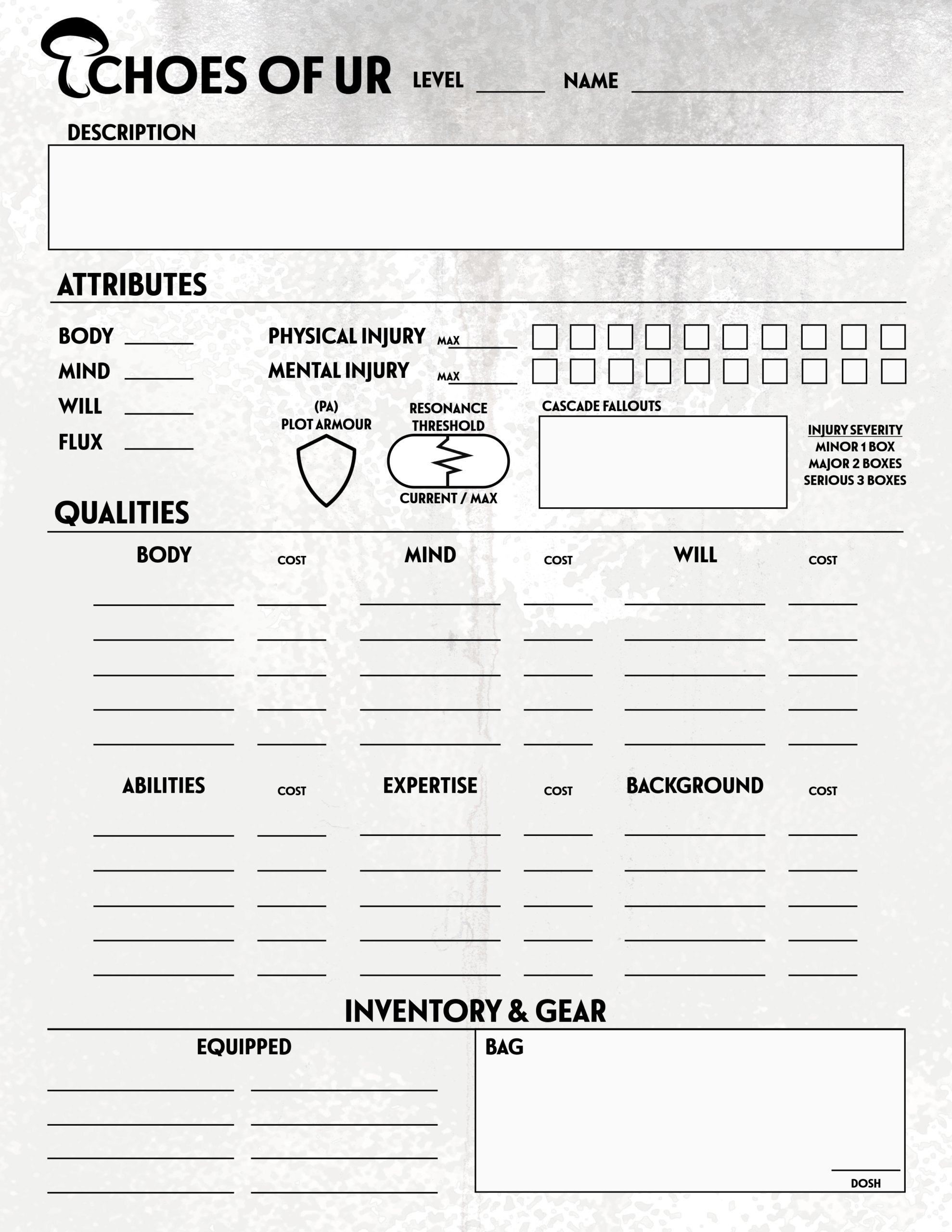
Step by Step Character Creation Guide
Step 1: Generate Stats
Distribute 10 points across your four core stats: Body, Mind, Will, and Flux. Each point in the same stat costs more than the last. The first point costs 1, the second costs 2, the third costs 4, the fourth costs 8, and the fifth costs 16. No stat may exceed 5 at character creation. Points not spent are lost.
This doubling cost means most characters will begin with no single stat above 3. A character who puts 3 points into Body spends 7 of their 10 points, leaving only 3 for everything else. That is a deliberate constraint. You are building a starting point, not an endpoint. Specialization happens through leveling.
Example: A player spends 3 points on Mind (cost: 1+2+4 = 7), 1 point on Will (cost: 1), and 1 point on Flux (cost: 1), spending all 10 points. Body remains at 0. That character is sharp, perceptive, and fate-attuned but physically unremarkable.
Step 2: Calculate Derived Stats
Once your core stats are assigned, calculate your three derived stats. These values update automatically each time you gain a level.
Physical Injury Boxes = Body + Level. At character creation all characters begin at Level 1, so a character with Body 1 starts with 2 physical injury boxes.
Mental Injury Boxes = Mind + Will + Level. A character with Mind 3 and Will 1 starts with 5 mental injury boxes.
Resonance Threshold = Flux + Level. A character with Flux 1 starts with a threshold of 2. Resonance that exceeds this value triggers a Cascade.
Record all three values on your character sheet. They define how much punishment your character can absorb — physically, psychologically, and cosmically — before something breaks.
Step 3: Calculate Quality Capacity
Each quality category has a capacity value that limits the combined numerical value of qualities it can hold. Calculate each category now using your assigned core stats.
Body capacity = Body. Mind capacity = Mind. Will capacity = Will. Abilities capacity = Body + Flux. Expertise capacity = Mind + Flux. Background capacity = Will + Flux.
Example: A character with Body 1, Mind 3, Will 1, Flux 2 has the following capacities — Body: 1, Mind: 3, Will: 1, Abilities: 3, Expertise: 5, Background: 3.
Each category may contain up to five qualities regardless of capacity. Capacity limits the combined value of those qualities, not the number. A category at capacity can still gain a negative quality — it simply adds complexity rather than value.
Step 4: Choose Qualities
Fill each category with qualities, staying within the capacity and slot limits established in Step 3. Qualities must fit the fiction and the Guide's setting. If a quality does not make sense for the campaign, it cannot be taken.
Positive qualities improve your character's capabilities. Negative qualities complicate them. Both occupy slots and both count toward capacity. Negative qualities do not increase capacity — they add depth, not numbers. Choose them because they make your character more interesting, not because you are trying to optimize the math.
You do not need to fill every slot. Leaving room in a category means room to grow. Qualities can be added between sessions with the Guide's approval as your character develops through play.
Step 5: Starting Equipment and Resources
Determine your starting equipment based on your Background qualities, Expertise, and the Guide's established setting limits. Equipment is not an abstraction — it reflects who your character is and where they come from. A Genesian caste worker starts with different tools than a surface-born survivor. A character with medical Expertise might carry a field kit. A character with a criminal Background might carry things they would rather not explain.
Starting equipment may include tools and gear, currency or trade goods, contacts or access points, and minor technology or alien artifacts. The Guide has final say over what is available at the start of a given campaign.
Step 6: Review and Begin
Before play begins, confirm the following. Each quality category is within its capacity value. No category exceeds five qualities. Resonance starts at 0. All three derived stats are calculated correctly. Equipment and access reflect your Background and the Guide's setting. Any remaining questions are resolved with the Guide before pressure is applied.
This is the last moment to adjust before the story begins. Once the first roll hits the table, your character is no longer a sheet of numbers. They are a person in a world that does not care about their intentions — only their choices.
Scenes
Leveling Up
Characters in Echoes of Ur grow through survival. Not through grinding enemies or completing quests, but through enduring the moments where the strings of fate snap back the hardest. Experience is not given for showing up. It is earned by living through what a Cascade leaves behind.
Earning Experience
When a player survives a Resonance Cascade they triggered, they earn experience points equal to their total Resonance multiplied by their current level. A level 3 character whose Cascade was triggered by 7 Resonance earns 21 XP. The greater the pressure allowed to build before it broke, the greater the reward for enduring what came next. Experience is individual. Each player tracks their own XP separately. There are no shared pools and no group rewards. What you survive is yours.
Leveling Up
The amount of experience required to reach the next level is calculated as follows: add your current level to itself, then multiply the result by your current level. A character at level 3 needs (3+3)*3 = 18 XP to reach level 4. The curve climbs steeply — early levels pass quickly, mid game levels require sustained play, and late game levels demand endurance across many sessions.
When a character reaches the required XP total they level up immediately. There is no overflow — any experience earned beyond the threshold is lost. Timing matters. A character who needs 3 more XP to level and survives a Cascade worth 20 XP gains exactly 3 and loses the rest. Awareness of your own XP total is part of playing the game well.
Upon leveling up, the character gains 1 point to assign to any core stat of their choice. Body, Mind, Will, or Flux — the choice reflects how the character has grown through what they have survived. No stat may exceed 10. Recalculate all derived stats immediately after assigning the point.
What Changes When You Level
Each level increases the character's derived stats automatically. Physical injury boxes increase by 1 since they are calculated as Body + Level. Mental injury boxes increase by 1 since they are calculated as Mind + Will + Level. Resonance Threshold increases by 1 since it is calculated as Flux + Level. These increases happen every level regardless of which stat you assign your point to, meaning every level makes a character meaningfully more resilient and harder to cascade.
Advanced Starting Levels
Not every campaign begins at level 1. The Guide may establish a starting level that better fits the tone and scope of the story being told. A street-level survival campaign might begin at level 1. A story about seasoned operatives might begin at level 4. An endgame campaign about legends pushing against the edges of reality might begin at level 7.
When starting at an advanced level, characters generate stats and qualities as normal during character creation, then apply the following for each level above 1. Assign 1 point to any core stat per level gained, respecting the stat cap of 10. Recalculate all derived stats after all points have been assigned. XP starts at 0 regardless of starting level — the character arrives at the table already forged by experience the players do not need to replay.
The Guide should communicate the starting level before character creation begins, as stat point distribution across multiple levels is a meaningful part of building an advanced character. A level 4 character has 3 additional stat points beyond creation to assign, and where those points went tells a story about who that character became between then and now.
The Shape of Progression
Early levels move fast by design. A level 1 character needs only 2 XP to reach level 2, and even a small Cascade gets them there. This is intentional — the first few levels are an on-ramp, a chance for players to experience the full loop of Resonance building, Cascade triggering, and leveling up before the curve steepens. By level 4 the requirements become meaningful. By level 7 they demand real investment. Level 10 is a landmark, not a guarantee.
There is no hard ceiling. The math does not stop at level 10. But the XP requirements grow steep enough that progression beyond level 10 is measured in campaigns rather than sessions. Characters at that level are already legends. What they become after that is a question the story will have to answer.
Qualities
Body Qualities
1 Cost
You only need 4 hours of sleep each night. You may shrug off your sleep requirement by another 24 hours by gaining 1 Echo.
You can breath oxygen while in or out of water. The water type does not matter (salt, freshwater, brackish, etc).
You may push your body to the limit once a day to gain 2d10s to a Body check to lift, push, pull, drag, swim, run, and jump. (This does not apply to attacks).
You're too cute and may add 1d10 to any flatter, persuade, or performance check.
Positive.
You may see in the dark up to 300 ft without the need of a light source.
Cybernetic. This is a cybernetic implant. These effects require the implant to be functional.
Your face is covered in unsightly pimples. You receive 1 failure on persuasion, diplomacy, or flattery checks.
You are an albino. You sunburn easily, and your eyes are sensitive to light. Additionally, you automatically gain 1 fail on perception checks while light is moderately bright. You Auto-fail all perception checks while you are looking into a light source.,
You have a visible implant that is damaged beyond repair. You may have this quality removed and replaced with an equal cost cybernetic.
Cybernetic. This is a cybernetic implant. These effects require the implant to be functional..
You have a noticible limp. Take 10% additional fall damage.
You experience intestinal discomfort after each meal and while experiencing distress. You gain 1 automatic failure on stealth checks.
2 Cost
You gain 1d10 on checks to endure physical stress such as exhaustion, fatigue, soreness, pain, and feinting.
Gain 1 additional bodily injury box.
You run hot all the time. You do not experience the effects of being chilled. This does not prevent freezing, but you are capble of enduring cold weather and temperatures that normal people could not.
Add 2d10s to any run, jump, swim, or kick check. Reduce all fall damage by 50%.
Cybernetic. This is a cybernetic implant. These effects require the implant to be functional. Cybernetic Qualities may be swapped out at any time.
Your skin is plated with tiny mirrors and crystals, allowing you to blend in with your surroundings.
Cybernetic. This is a cybernetic implant. These effects require the implant to be functional. Cybernetic Qualities may be swapped out at any time.
You aren't just surefooted, you glide. You are able to remain silent while wearing any footwear. This quality negates difficulty walking on slippery or sticky surfaces.
You may not run. Movement uphill takes twice as long.
You do not fit through small spaces such as vents, manholes, crawlspaces, small vehicles, and areas smaller than 5 cubic feet.
In addition to enemies, allies cannot pass through your space.
You may add 1d10 to every check you may while in darkness (such as at nighttime or while underground).
You gain 1 automatic failures to every check you make while in low-light, daylight, and while targeted by light sources.
You may only get sustencence from sunlight or light sources such as candles, flashlights, overhead lights, or ultraviolet light.
You take an additional 100% fire damage.
You have either lost an eye or were born with only one. Gain 1 automatic failure on perception, driving, and piloting checks involving sight and attacks involving your aim.
3 Cost
Gain 2d10 on any raw strength check for actions involving pushing, pulling, dragging, lifting, throwing, jumping, running, or swimming. (This does not include attacking)
Add a 2d10 to any melee attack, gain 2 echo. (Repeatable)
You and your reflexes are faster than normal. Gain 2d10 on evade, dodge, and run checks.
Your movement speed doest not affect stealth.
You have 2 additional robotic arms with detachable claws. They may function exactly as your normal arms.
You may take this quality additional times and add 2 arms each time.
Cybernetic. This is a cybernetic implant. These effects require the implant to be functional.
You are armoured whether you wear armor or not. This can be a sheel, plating, scales, feathers, fur, or hair.
Condition: Armoured. You may ignore 1 minor body injury per attack.
You have a small 3d printer installed in your head that 3d prints small, functional objects out of your hair. You may spend 1 hour printing a lockpick, twine, wigs, or anything 12 cubic inches or smaller.
Also, you have alopecia.
Cybernetic. This is a cybernetic implant. These effects require the implant to be functional.
You are distractingly ugly. Gain 2 auto failures on any diplomacy, bluff, hypnotize, flattery, bribe, or intimidate checks.
Anyone who looks at you while performing a check of any kind gains 1 auto failure.
Your legs do not function or are not strong enough to support your weight.
You gain 1d10 on any checks you perform while stationary.
You cannot see. You fail any visual check.
If you use cybenetic implants involving vision they do not function.
You gain 2d10 on any perception checks involving hearing and smelling.
You gain 3 automatic failures to resist disease, illness, fatigue, or poison. You must take medication every 24 hours to reduce this effect by 1.
You are missing at least 1 limb and you auto fail any checks involving those limbs. You may use a cybernetics to negate these effects.
You may take this only once, but change the number of limbs removed if you lose more limbs after the first.
Mind Qualities
1 Cost
You may pass any general knowledge test without rolling, gain 1 echo.
2 Cost
Choose one domain:
- Biology
- Engineering
- Astrophysics
- Physics
- Geology
- Sociology
- Psychology
- Chemistry
- Math
- Zoology
- Technology
- Pharmaceuticals
- Culture
- Agriculture
- Business
- History
- Religion/Occult
Gain 2d10 regarding knowledge checks involving that domain.
This may be taken multiple times, choosing a different domain at the same time.
Choose two domains:
- Biology
- Engineering
- Astrophysics
- Physics
- Geology
- Sociology
- Psychology
- Chemistry
- Math
- Zoology
- Technology
- Pharmaceuticals
- Culture
- Agriculture
- Business
- History
- Religion/Occult
You may add 3d10s to any knowledge checks involving those domains. Any knowledge checks of domains you have not chosen result in as 2 automatic failures.
You may only take this quality once.
You are constantly connected to a network of computers. Gain 1 auto success on checks to identify a person, human technology, or customs. You know everybody's name unless a quality prevents this.
Cybernetic. This is a cybernetic implant. These effects require the implant to be functional. Cybernetic Qualities may be swapped out at any time.
3 Cost
You are immune to mind-control and confusion. You gain 1d10 when rolling any mind related checks to remember something, resist mind effects, and be hypnotized.
Add 1d10 to any knowledge check, gain 2 resonance.
You gain 1 auto success on any knowledge check, gain 1 resonance.
You may add 1d10 to any Knowledge, Mind, or Expertise check.
This is FAQ answer. Click to edit this text. Lorem ipsum dolor sit amet, consectetur adipiscing elit. Ut elit tellus, luctus nec ullamcorper mattis, pulvinar dapibus leo.
You can perfectly recall any experience you saw, heard, felt, tasted, or smelled.
You cannot be confused or lose memories. You may also gain 1d10 on seeing through illusions and deceptions.
Will Qualities
1 Cost
So long as you are under the effects of drugs, you may remove 1 minor mental damage every 4 hours.
You can read people's vibe. You may determine a human's intent by observing them.
You can detect when someone you can observe is hostile, angry, neutral, friendly, happy, sad, depressed, enchanted, or frightened.
So long are you are not under the influence of drugs or alcohol you may add 1d10 to any will or mind based checks.
If you consume any drugs or alcohol you lose the benefits of this quality until you have been sober for 24 hours.
So long as you are under the influence of drugs or alocohol, or while you are drunk, you gain 1 additional d10 to any flattery, bribe, intimidate, coerce, diplomacy, persuade, or seduce check.
Your character has a pet peeve. Determine your pet peeve on character creation. The guide is the judge of what seems relevant and realistic for your character.
Witnessing or being in the presence(30 ft) of your pet peeve gives you 1 auto failure on will based checks that involve the pet peeve.
2 Cost
Exert your will over others. Gain 2d10 when trying to persuade, intimidate, bribe, or flatter a non-player.
Social Alignment
-
+3 Bestie
-
+2 Friend
-
+1 Acquaintance
-
0 Neutral
-
-1 Annoyance
-
-2 Rival
-
-3 Enemy
You have a phobia related to one of the following domains:
-
Arachnophobia – Fear of spiders
-
Ophidiophobia – Fear of snakes
-
Acrophobia – Fear of heights
-
Agoraphobia – Fear of open spaces or situations where escape feels difficult
-
Social Phobia (Social Anxiety Disorder) – Fear of social situations or being judged
-
Claustrophobia – Fear of enclosed spaces
-
Trypanophobia – Fear of needles or injections
-
Thanatophobia – Fear of death or dying
-
Cynophobia – Fear of dogs
-
Aviophobia (Aerophobia) – Fear of flying
You gain 2 auto failures on any activity related to the chosen domain.
3 Cost
You may auto-succeed a persuasion, bribe, intimidate, deception, diplomacy, or similar checks, gain 2 echo.
You are immune to charm and fear.
Ability Qualities
1 Cost
You may create a concussive, sonic wave of force in a 15 ft cone in front of you using your body, implants, weapons, or tools.
Organic creatures are knocked back 10ft from the source of the boom and take 1 minor injury if they are knocked down.
All constructs or crystalline creatures take 1 major injury and are knocked down.
You may empower a handful of items with psychic energy that hurts those you throw them at.
Add 1d10 to attacks involving the empowered items. If you damage the target, you apply 1 minor injury for every injury already on the target.
You have a tendency to find hidden things or activate hidden doors/consoles/buttons.
Add 1d10 to attempts to find hidden objects, doors, mechanisms, furniture, or concealed passages.
You may use your body or cybernetics to generate a moderate, but short-lived flame spurt that burns and lights a small area.
Creates a flash of light that can temporarily blinds anyone sensitive to light. Burns a target, gain 1d10 on rolls to use Spark as an attack. This attack adds no damage to the attack, but will ignite any hit enemy to promote a minor injury into a major injury.
2 Cost
While you are drunk, you gain 1d10 to attack, evade, dodge, tumble, and flattery checks; and you gain 1 plot armor.
If you also have the Drunk Quality you may also add an additional 1d10 to the mentioned checks.
This is FAQ answer. Click to edit this text. Lorem ipsum dolor sit amet, consectetur adipiscing elit. Ut elit tellus, luctus nec ullamcorper mattis, pulvinar dapibus leo.
You may intrude other human's dreams and perform one diplomacy, bluff, flattery, bribe, or intimidate check.
If successful on this check you may speak with the other human as tho you were both awake and in the same room. The subject does not remember this dream. You may add 1d10 to any other diplomacy, bluff, hypnotize, flattery, bribe, or intimidate checks while in this dream.
They may not wake up, until you choose to as well.
3 Cost
Expertise Qualities
1 Cost
You may gain 1d10 to hacking any human technology. You may auto-succeed a hacking attempt for 1 echo.
You may gain 1d10 to checking the medical condition of a human. You may heal 1 minor injury on yourself or others for 1 echo.
You may gain 1d10 to any checking driving or piloting any vehicle (includes makeshift/primitive items such as hang-gliders or sleds).
You may gain 1d10 on checks involving using tools such as jackhammers, shovels, welding jig, pickaxes, wrenches, crowbars, and other hand-tools.
You gain 1d10 to diagnose and prescribe treatment for any human injury or illness. You may create makeshift drugs to treat any human injury or illness. (Makeshift drugs are 1/2 as potent as regular drugs)
Choose an instrument. You may gain 2d10 on any performance check involving that instrument. You may gain 1d10 on any performance check involving any instrument, gain 1 echo.
Background Qualities
1 Cost
You know your way around Genesis, gain 1d10 on any check regarding the location of any business, residence, or landmark within Genesis.
You know the territories of the tribe, gain 1d10 on any check regarding the location of any business, residence, or landmark within 30 miles of your territory.
You are familiar with your alien habitat, gain 1d10 on any check regarding the location of any business, residence, or landmark within your alien habitat.
2 Cost
You are well known by your home city, tribe, caste, and community.
You may add 2d10 on diplomacy, bluff, flattery, bribe, or intimidate checks involving people who know you.
You learned to be alone and depend on yourself while spending time in the wilderness or places with very few people.
You may add 1d10 to survival checks or checks to find or create shelter, food, water, or cover.
You may also add 1d0 to stealth checks in familiar territory.
You cannot go more than 2 hours without taking a drink of alcohol. You cannot go more than 24 hours without being drunk.
You automatically gain 1 failure on all mind and will related checks.
Condition: Drunk. While drunk the player always starts last in combat and automatically gain 1 failure on dodge, evade, run, swim, jump, and climb checks.
BODY
|+| Iron Stomach — 1 Cost You can eat or drink almost anything without ill effect. You are immune to food-based poisoning and may consume contaminated water, spoiled food, or alien organic matter without penalty.
|–| Twitchy — 1 Cost Your nervous system runs hot. You gain 1 automatic failure on any check requiring stillness, precision, or patience such as lockpicking, sniping, or surgery.
|+| Scar Tissue — 2 Cost Years of damage have made you harder to hurt in familiar ways. You may ignore the first minor injury dealt by any attack type that has injured you before in this session.
|–| Hollow Bones — 2 Cost Your skeleton is fragile, either by mutation or medical condition. Lose 2 physical injury boxes permanently. You gain 1d10 on any check involving speed, agility, or fitting into tight spaces.
MIND
|+| Pattern Recognition — 1 Cost You notice when things are wrong before you can explain why. The Guide must tell you when something in your immediate environment is out of place, even if you do not know what it means yet.
|–| Paranoid — 1 Cost You trust no one easily. Gain 1 automatic failure on any diplomacy or cooperation check with someone you have known for less than one session.
|+| Eidetic Trigger — 2 Cost You cannot recall everything perfectly, but sensory triggers unlock vivid memory. When you encounter a smell, sound, or texture connected to a past experience the Guide may reveal a detail you did not know you remembered.
|+| Cryptographer — 3 Cost You may decode any written language, cipher, or alien symbol system given enough time. You may auto-succeed any check to read, decode, or translate written information, gain 1 Resonance.
WILL
|+| Unshakeable — 1 Cost You have seen enough that very little surprises you anymore. You are immune to the frightened condition and gain 1d10 on checks to resist panic or intimidation.
|–| Martyr Complex — 2 Cost You have difficulty letting others take risks you could absorb yourself. When an ally takes an injury you could have prevented, gain 1 automatic failure on all checks until you do something to make it right.
|+| Cold Read — 2 Cost You can size someone up in seconds. Once per scene you may ask the Guide one question about an NPC's motivation, loyalty, or emotional state and receive an honest answer.
ABILITIES
|+| Static Field — 1 Cost You generate a low level electromagnetic interference. Any unshielded electronic device within 5 feet of you has a 50% chance of malfunctioning. You may suppress this ability deliberately but not permanently.
|+| Adrenaline Surge — 2 Cost Once per scene when you take a major or serious injury, you may ignore its mechanical effects until the end of the current bout. The injury still exists. You just do not feel it yet.
|+| Dead Drop — 2 Cost You can fall from any height without taking fall damage so long as you have at least one surface to interact with on the way down. Walls, pipes, bodies, and debris all count.
|+| Overclock — 3 Cost You may push your mind or body beyond its normal limits for one roll, adding 2d10 to any single check. Gain 2 Resonance. This may only be used once per scene.
EXPERTISE
|+| Scrapper — 1 Cost You know how to fight dirty. Gain 1d10 on any unarmed attack or improvised weapon attack.
|+| Field Medic — 2 Cost You can treat injuries without proper equipment. You may heal 1 minor injury using only materials available in the environment. You may heal 1 major injury with a full medical kit, gain 1 Resonance.
BACKGROUND
|+| Contraband Contact — 1 Cost You know someone who can get things that are not supposed to exist. Once per session you may request any item of moderate rarity. The Guide determines availability, cost, and complications.
|–| Wanted — 2 Cost You have a price on your head. Security forces, bounty hunters, or a specific faction are actively looking for you. The Guide may introduce complications related to your status at any time.
|+| Veteran of the Surface — 3 Cost You survived outside the dome long enough that the wilderness no longer frightens you. You auto-succeed all survival checks in outdoor or wilderness environments and gain 2d10 on any check involving navigation, foraging, or tracking, gain 1 Resonance.